Thursday, 13 October 2011
Visitandines
"Now is the winter of our discontent / Made glorious summer by this son of yolk", as Shakespeare did not quite write. But discontent was indeed in Divine Cherry's heart, and eggs were truly in her hands. Her dissatisfaction came from Small Perfect Cloud's newfound habit of chewing and gnawing at the herbs she and Celestial Dragon had planted earlier that century – not unlike a mouse, which is odd for a cat. And the eggs in her hands came from the supermarket. So there she was. What to do, what to do? It so happened that Divine Cherry was curious to try something new. It also so happened that Celestial Dragon had recently brought form one of his innumerable travels a small and quite delicious delicacy he claimed was called "small ovens". Figures.
But as Desire is Despair's twin, and Delight its younger sister, Divine Cherry took her discontent and her eggs and set about to transform them, to transmute them, to transcend them even by replicating one of the loveliest "small ovens" (or petit fours in French) of all times: the Visitandines. It was exactly what she needed: their softness appealed to her; their sweetness gladdened her spirit; their fluffiness warmed the cockles of her heart; and their sheer deliciousness induced in her imagination such a forceful ecstasy that she could refrain herself no more. She therefore produced forth her trusty grimoire and set about to prepare these petit fours (which were later also used to perfume the palace).
This is how she did it:
Visitandines (recipe taken from "Le Larousse des Desserts" by Pierre Hermé)
Ingredients:
-4 egg whites (from medium-sized eggs)
-40g of flour
-185g of butter
-125g of granulated sugar
-125g of almond flour (or extremely finely grounded almonds)
Preheat the oven at 200°C. Put 3 egg whites in a bowl and whisk them to snow – but not too firm. Leave the remaining egg white in the fridge. Mix the sugar with the ground almonds, then add the flour and the 3 beaten whites. Incorporate the (previously) molten butter. Now vigorously whip the last egg white to firm snow and add it carefully to the mixture.
Grease 12 muffin moulds (or 6 normal muffin moulds and 12 mini-muffin moulds in order to get smaller visitandines like the ones shown in the picture) with butter, fill them with the mixture and put them in the oven for 8-10mins. You know they're ready when they're golden on the outside and still soft on the inside.
Ricetta in italiano:
Visitandines (Ricetta tratta da "Le Larousse des Desserts" di Pierre Hermé)
-4 albumi (uova medie)
-40g farina
-185g burro
-125g zucchero semolato
-125g farina di mandorle
Accendere il forno a 220° C. Mettere in una ciotola 3 albumi e sbatterli senza montarli completamente. Lasciare l'altro albume in frigorifero. Mescolare lo zucchero con le mandorle ridotte in polvere, aggiungere la farina e i 3 albumi sbattuti. Incorporare il burro fuso aglia altri ingredienti. A parte montare a neve molto ferma l'albume rimasto e aggiungerlo con delicatezza al composto.
Imburrare 12 stampini da muffin (o 6 da muffin e 12 da mini-muffin per avere delle tortine piu' piccole come ho fatto io), versare il composto e infornare per 8-10 minuti, finche' risulteranno dorati all'esterno e ancora morbidi all'interno.
Enjoy,
And Spread the Mess
Monday, 10 October 2011
Aubergine boats
The world was afloat. Heavy clouds hung low on the horizon, and grey waters splashed the sidewalks. The tall buildings of tomorrow had fallen already. Distant ships fought against rising waves, and a dimmed sun glowed coldly in the ashen sky. It was dreadful. It was horrible. It was a nightmare. Celestial Dragon woke up with a start. Panicked and sweating, he looked blankly at the ceiling. Divine Cherry was still sleeping. Celestial Dragon looked at her in the twilight of the early hours. She was beautiful; divine, really. 'No kidding,' he thought. Soon after Divine Cherry woke up as well.
'I've had a dream,' she said.
'Well all have,' Celestial Dragon replied.
'Maybe, but mine was made of aubergine.'
Celestial Dragon left it at that.
Six hours later, when Celestial Dragon returned to his palace, he found Divine Cherry at the grips with a just-out-of-the oven boat-like aubergine. And he saw that it was good. And when they sat down to partake of the meal Divine Cherry had laid out for them, he knew that it was very good.
'How did you do it?' asked Celestial Dragon in wonder.
And this is what Divine Cherry replied:
'First, I cut the two aubergines in half and carved them, grid-like. However, I made sure to leave about half a centimetre around the rim intact. I then, with a spoon, gauged out the inside of the aubergines, which, due to the cuts I had made previously, fell out in cute little cubes. Again, however, I made sure to leave about half a cm of flesh on the bottom of my little veggie-bowl. I then salted the aubergines, sprayed them with a bit of olive oil and put them in the preheated oven at 200°C for 20mins. Another way of doing it, if for some reasons one would have trouble with the number "20", would be to leave them in the oven until the flesh on the inside of aubergine is well cooked.
While the veggie-boats – and aren't they cute? – were roasting in the oven, I chopped half an onion and lightly fried it in a pan with some olive oil. You know, standard procedure. I also cut the carrot and the celery stick, but not too small, for I wanted for you to be able to taste them at the end. I then added everything to the slowly simmering onions and lightly fried them as well. I also added a bit of water when I saw that they were kind of drying out. Anyway, once they were nearly done, I added the scooped out aubergine flesh as well as the olives I had already cut. In another pan, I prepared the tomato sauce. Do you remember that dish you made, long ago, where you added a bit of vegetable stock to the milk? Well I used that one, I hope you don't mind. I put the tomato sauce to simmer with a bit of oil and added a bit of warm milk with a fragment of melted stock as well. Now once the vegetables were good and done, I simply added the tomato sauce in there and stirred well.
By now, the veggie-boats were ready as well. The next step should be obvious. Yes, I filled them with the vegetables-in-tomato-sauce. I then generously sprinkled the cheese on top of them and shoved them in the oven for another 15mins, et voilà. I hope you like it.'
Celestial Dragon nodded in sincere approval. He was sure that no nightmare would come to haunt his dreams that night. He looked at his plate, lifted his fork, observed it, and smiled at Divine Cherry.
Ingredients (serves 2):
-2 aubergines
-half a carrot
-half a stick of celery
-half an onion
-a glass of tomato sauce (to which you add a tbsp of milk with vegetable stock)
-10 green olives
-a generous helping of Parmigiano
-a piece of mild Cheddar (or any easily melting cheese with not too strong a flavour)
See above for the recipe.
Ricetta in italiano
Per 2 persone
-2 melanzane
-Mezza carota
-Mezza costa di sedano
-Mezza cipolla
-Un bicchiere di sugo al pomodoro (+un cucchiaio di latte e un frammento di dado vegetale)
-10 olive verdi
-Abbondante parmigiano
-Un pezzo di cheddar (o formaggio che si fonde facilmente dal sapore non troppo forte)
Tagliare a meta’ le melanzane nel senso della lunghezza e inciderle a griglia (fare delle incisioni con il coltello in diagonale prima in un senso e poi nell’altro) . Lasciando intatto circa mezzo centrimetro intorno al bordo. Scavare la parte centrale della melanzana. La polpa a questo punto si stacchera’ gia’ a cubetti. Avere cura di lasciare uno strato di polpa di almeno mezzo centrimetro abbondante attaccata alla buccia. Salare le barchette di melanzana, cospargere un filo d’olio e infornare a forno caldo a 200°C per 20 minuti (o fino a quando la polpa sara’ ben cotta).
Nel frattempo tagliare la cipolla a fettine e metterla in una padella con un po’ d’olio. Tagliare anche le carote e il sedano a fettine sottili (ma non tritare, i pezzettini alla fine si dovranno sentire). Aggiungere queste verdure alla cipolla e portare a cottura aggiungendo anche mezza tazzina d’acqua se le verdure di dovessero asciugare troppo. Quando le altre verdure sono quasi pronte aggiungere i cubetti di melanzana e le olive tagliate a pezzetti e rosolare. A parte praparare il sugo: mescolare alla passata un cucchiaio di latte caldo in cui avrete fatto sciogliere una puntina di dado vegetale granulare (in realta’ questo sugo era una avanzo ed era gia’ preparato cosi. Poiche per la ricetta vi serve poco pomodoro, potete farne di piu’ e metterlo via o usare anche voi della salsa di pomodoro avanzata in precedenza). Quando le verdure sono cotte, aggiungere il sugo di pomodoro e ultimare la cottura.
Farcite le barchette di melanzana con la padellata. Tritare grossolanamente il formaggio e versarlo sulle barchette farcite, spolverizzare di parmigiano grattuggiato e infornare per 15 minuti finche’ il formaggio avra’ un bel colore dorato.
Enjoy,
And Spread the Mess
Thursday, 6 October 2011
Caramel Chantilly Puffs
Imagine a garden. Imagine the gentle green hill on which there is this garden. Imagine also all the flowers, all the trees. Visualise, on the top of the hill, in the middle of the garden, a white Roman-style bench with white, soft, fluffy cushions; and next to it, facing the vastness beyond, the Venus of Milo. She's eating an apple. You can feel the sleepiness that permeates the place, the gentle lushness of the senses that fills the seconds with fragments of eternity. Visualise the birds as well – hear them singing Nessun Dorma: a very popular tune with Nightingales – and the fireflies that glow in vain in the mid-afternoon light. Picture Divine Cherry on the bench, her eyes closed, watching the sky (because she can). And picture Celestial Dragon too: he is standing next to her, a cloud in one hand, a sun in the other. Now focus your gaze on Celestial Dragon. Zoom in, closer, closer, there. See what he is doing? No? Why, he's being curious: he is trying to stuff the sun with a cloud. Or vice versa. Just to see what happens.
And then it hits him (literally). The rest of the Venus of Milo's apple has performed a high arch in the blue blue sky and has fallen on Celestial Dragon's head. Incidentally, at that very same moment, Celestial Dragon was also hit by an idea (so precise was the timing that he could later not recall what had come first: the blow or the thought). Still in that same instant, Divine Cherry opened her eyes and saw, in a flash, the ultimate truth: namely that the blow and the thought are one and the same thing. But Celestial Dragon's idea was actually a good one. In effect, he kept the cloud firmly in one hand and poured, with his other hand, liquid sun on it. He then blew on it until it solidified, and then poured the hottest sun-juice on the solid surface in order to give a bit of sheen and varnish. And that is how the idea of the Chou Au Caramel was born. The rest is just magic. And hunger.
Puffs coated with caramel and filled with Chantilly cream.
Puffs (the recipe is from Cavoletto. I write it down here without major changes):
Ingredients:
Puffs (the recipe is from Cavoletto. I write it down here without major changes):
Ingredients:
- 150 g plain flour
- 5-6 medium eggs
- 125 g milk
- 125 g water
- 100 g butter
- 1 teaspoon sugar
- 2,5 g (half teaspoon) of salt
In a saucepan, mix the milk with water. Add butter, a teaspoon of sugar and a pinch of salt. Bring the mixture to a boil. Remove the saucepan from the heat and add the flour all at once. Stir with a wooden spoon until it forms a ball. Bring on the fire again and cook a few minutes in order to dry the dough.
Transfer the cooled ball in a bowl and add one egg at a time, stirring well before adding the next egg. Continue adding eggs until the dough will fall from the wooden spoon forming long peaks. This usually happens after 4 or 5 eggs have been added (for this amount of dough).
Put the dough in a piping bag with smooth nozzle and form lumps the size of walnuts on a greased baking sheet. Use a wet finger to smooth the top of the puffs. Bake in the oven for 10 minutes at 200°C until the lumps are puffed and golden.
Chantilly Cream: 250g of crème patissière mixed with 85 g of whipped cream.
Crème Patissière (Recipe taken from "Le Larousse des Desserts" by Pierre Hermé)
- 2 egg yolks
- 175g milk
- 40 g sugar
- 15 g cornflour
- 1 vanilla pod
- 17g butter
In a saucepan, bring to boil the milk with the cornflour, half of the sugar and the seeds of a vanilla pod. Bring to a boil, stirring constantly with a whisk in order to avoid lumps. In a separate bowl, beat the egg yolks with the remaining sugar for a few minutes until you obtain a pale yellow mixture. Move the milk from the heat and add the egg yolks mixture, stir and bring back on the fire. Continue cooking, stirring with a whisk until it will have thickened. Once the cream is thick enough, transfer the pan into a bowl filled with iced water so as to quickly lower the temperature. Add now the piece of butter (the cream will be warm) and stir to melt.
Transfer the cooled crème into a bowl and cover with cling film until ready to use.
- 5-6 medium eggs
- 125 g milk
- 125 g water
- 100 g butter
- 1 teaspoon sugar
- 2,5 g (half teaspoon) of salt
In a saucepan, mix the milk with water. Add butter, a teaspoon of sugar and a pinch of salt. Bring the mixture to a boil. Remove the saucepan from the heat and add the flour all at once. Stir with a wooden spoon until it forms a ball. Bring on the fire again and cook a few minutes in order to dry the dough.
Transfer the cooled ball in a bowl and add one egg at a time, stirring well before adding the next egg. Continue adding eggs until the dough will fall from the wooden spoon forming long peaks. This usually happens after 4 or 5 eggs have been added (for this amount of dough).
Put the dough in a piping bag with smooth nozzle and form lumps the size of walnuts on a greased baking sheet. Use a wet finger to smooth the top of the puffs. Bake in the oven for 10 minutes at 200°C until the lumps are puffed and golden.
Chantilly Cream: 250g of crème patissière mixed with 85 g of whipped cream.
Crème Patissière (Recipe taken from "Le Larousse des Desserts" by Pierre Hermé)
- 2 egg yolks
- 175g milk
- 40 g sugar
- 15 g cornflour
- 1 vanilla pod
- 17g butter
In a saucepan, bring to boil the milk with the cornflour, half of the sugar and the seeds of a vanilla pod. Bring to a boil, stirring constantly with a whisk in order to avoid lumps. In a separate bowl, beat the egg yolks with the remaining sugar for a few minutes until you obtain a pale yellow mixture. Move the milk from the heat and add the egg yolks mixture, stir and bring back on the fire. Continue cooking, stirring with a whisk until it will have thickened. Once the cream is thick enough, transfer the pan into a bowl filled with iced water so as to quickly lower the temperature. Add now the piece of butter (the cream will be warm) and stir to melt.
Transfer the cooled crème into a bowl and cover with cling film until ready to use.
Note:
- The crème should be consumed within 12 hours of making because after this time it loses flavour.
- When preparing the Chantilly cream custard, I would advice to make it denser than usual, because adding the cream liquefies it a bit.
Whipped cream:
Whipped cream:
- 85 g fresh cream
Whip the cream with electric whisks. In order for it to work, the cream, the bowl and the whisks must be very cold. The cream should be cold from the fridge, while and the whisks and the bowl can be put in the freezer half hour before use.
I do not add sugar to the whipped cream, but in case you prefer it sweeter, add 8g of sugar when the cream is "half-whipped" and then continue beating.
Whip the cream with electric whisks. In order for it to work, the cream, the bowl and the whisks must be very cold. The cream should be cold from the fridge, while and the whisks and the bowl can be put in the freezer half hour before use.
I do not add sugar to the whipped cream, but in case you prefer it sweeter, add 8g of sugar when the cream is "half-whipped" and then continue beating.
Caramel and assembly:
In a saucepan, put 2 tablespoons of sugar and melt over medium-high heat without ever turning (this is very important: if you mix it, the sugar will form crystals and the caramel will be ruined).
Dip the head of the puffs rapidly in the hot caramel and place on a wire rack to cool.
Make a small hole to on the back of the puffs with a piping bag and fill them with the Chantilly cream.
The cream puffs are ready to be eaten!
Notes:
- The puffs should be filled at the last minute and eaten within a few hours.
- The empty puffs can be prepared in advance and subsequently frozen. They should then be placed, still frozen, into a very hot oven (220°C) before using them.
Ricetta in italiano:
Bignè ricoperti al caramello e farciti di crema Chantilly
Bignè (ricetta tratta dal Cavoletto che riporto qui senza grosse variazioni)
- 150 g farina
- 5-6 uova medie
- 125 g latte
- 125 g acqua
- 100 g burro
- 1 cucchiaino zucchero
- 2.5 g ( mezzo cucchiaino) di sale
In un pentolino mescolare il latte con l'acqua, Aggiungere il burro, il cucchiaino di zucchero e il pizzico di sale. Portare la miscela a ebollizione. A questo punto spostare dal fuoco e aggiungere la farina in una volta sola, mescolando con un mestolo di legno finché si formerà una palla. Riportare sul fuoco e cuocere qualche minuto l'impasto per asciugarlo.
Trasferire la palla intiepidita in una ciotola capiente e aggiungere un uovo alla volta, mescolando bene con il cucchiaio di legno prima di aggiungere l'uovo successivo. Continuare ad aggiungere uova finché l'impasto non cadrà dal mestolo formando lunghe punte. Questo di solito succede dopo aver aggiunto 4 o 5 uova per questo quantitativo di impasto.
Mettere l'impasto in una sac a poche a bocchetta liscia e formare dei mucchietti grandi come noci su una teglia da forno imburrata. Con un dito inumidito di acqua arrotondare i bignè (cioè' abbassare le svirgolata sulla testa del bignè formata dalla sac a poche). Infornare a forno calco a 200°C per 10 minuti fino a quando i bignè sono gonfi e dorati.
Crema Chantilly
250g di Crema Pasticcera a cui ho mescolato 85 g di panna montata.
Crema Pasticcera (Ricetta tratta da “Le Larousse des Dessert” di Pierre Hermé)
- 2 tuorli
- 175g di latte
- 40g zucchero
- 15g fecola
- 1 bacca di vaniglia
- 17g burro
- 2 tuorli
- 175g di latte
- 40g zucchero
- 15g fecola
- 1 bacca di vaniglia
- 17g burro
In un pentolino mettere a scaldare il latte con la fecola, metà dello zucchero e i semini di una bacca di vaniglia. Portare a ebollizione mescolando continuamente con una frusta per evitare la formazione di grumi. A parte mescolare con una frusta a mano i tuorli con il resto dello zucchero per qualche minuto in modo da ottenere una miscela giallo pallido. Spostare il latte dal fuoco e aggiungere i tuorli con lo zucchero, mescolare e riportare sul fuoco. Continuare la cottura senza smettere di mescolare con la frusta fino a che si sarà addensato. Una volta terminata la cottura trasferire il pentolino in un recipiente riempito di acqua ghiacciata per far abbassare velocemente la temperatura e a questo punto aggiungere il pezzetto di burro (la crema sarà tiepida) e mescolare per farlo sciogliere.
Trasferire la crema raffreddata in una ciotola e coprire con pellicola fino al momento di utilizzarla. La crema pasticcera va consumata entro 12 ore perché passato questo tempo perde di sapore.
Per fare la crema chantilly consiglio di fare una crema pasticcera più densa del solito, perché addizionando la panna diventa un pò più liquida.
Panna montata:
-85 g panna fresca
-85 g panna fresca
Montare la panna con le fruste elettriche. Per riuscire, sia la panna che il recipiente che la contiene e le fruste devono essere molto fredde. La panna quindi dev’essere fredda da frigo e le fruste e il recipiente si possono mettere in freezer mezz'ora prima dell’utilizzo. Io per la crema chantilly non aggiungo zucchero alla panna montata ma in caso la si volesse più dolce aggiungere 8g di zucchero quando la panna è semi montata e poi continuare a sbattere.
In un pentolino mettere 2 cucchiai di zucchero e farli sciogliere a fuoco medio-alto senza girare mai (questo è molto importante: se si cede alla tentazione di mescolare il caramello impazzirà formano cristalli di zucchero e non sarà piu' utilizzabile). Tuffare rapidamente la testa dei bignè nel caramello caldo e porli su una griglia a raffreddare.
- I bignè vanno farciti solo all'ultimo momento e mangiati entro qualche ora altrimenti si afflosciano.
- I bignè vuoti si possono preparare in anticipo e congelare. Vanno poi messi ancora congelati in forno molto caldo (220°C) prima dell'utilizzo.
Enjoy,
And Spread the Mess
Monday, 3 October 2011
Focaccia Pugliese
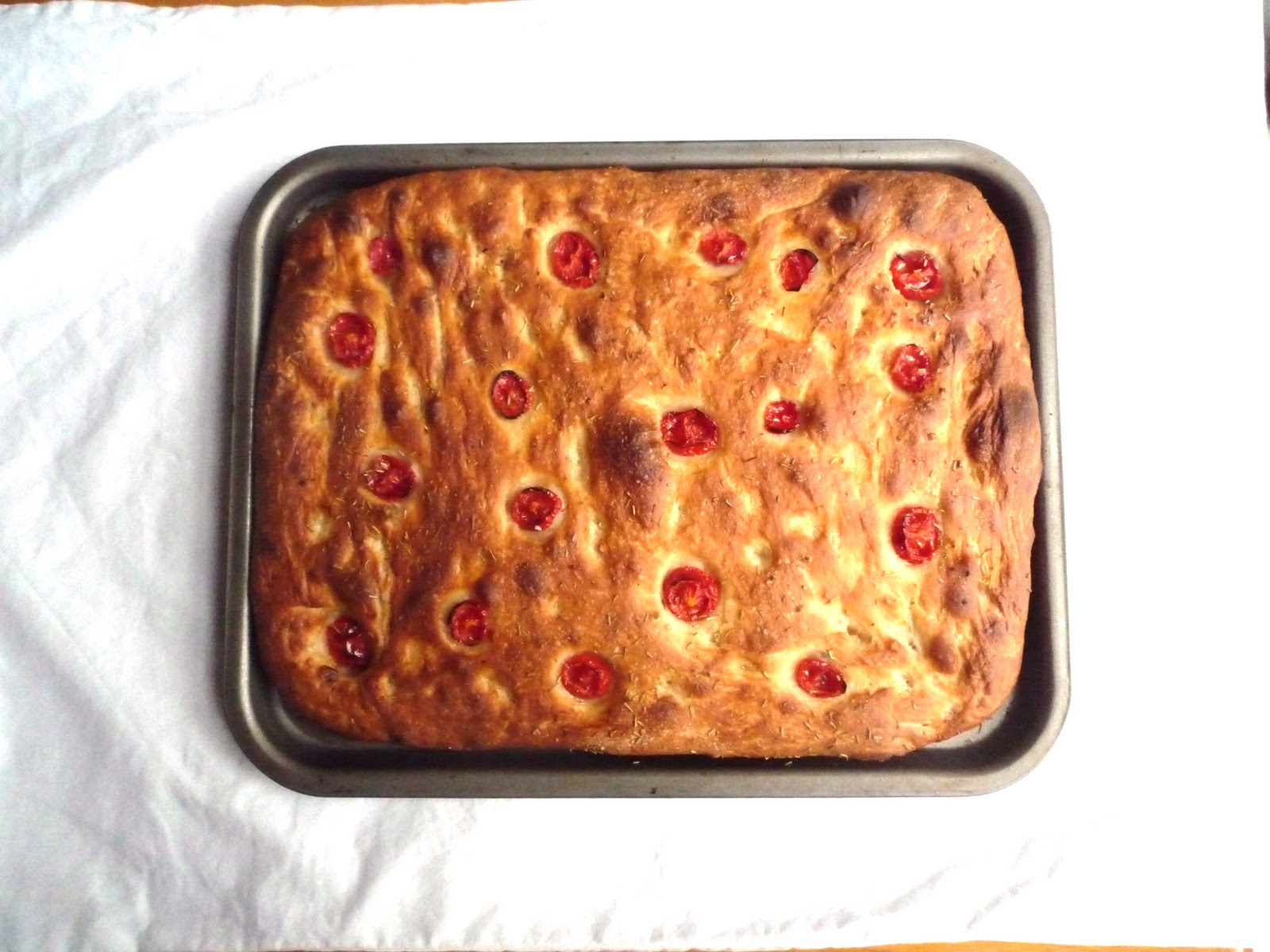
Would you look at that: Small Perfect Clouds is pacing up and down on the terrace. Nothing particularly interesting, you might say, but look closer. It is pensive, restless, but not agitated. It is calm, yet somehow disturbed. Something is the matter. It treads up and down, down and up; light-footed and light-minded. Small Perfect Cloud is at a loss. Something is missing, or something is feeling different. Somehow, Small Perfect Cloud is not itself today. And that is because it has had a dream. As any felinologist will tell you: a dreaming cat is a worried cat (especially since most cats dream of taking over the world but find it increasingly hard to actually do it due to the ever-expanding, all-encompassing Mouse Conspiracy that rules the underground). But the true reason why they're so worried is that cats' dreams are not like other, normal dreams. As opposed to most other beings, cats dream truths, not fictions and fantasies. That's the reason why they are the wisest animals in the world: after all, they sleep up to 16 hours a day; and 16 hours a day of truth will tell you quite a bit about the world. You may even discover why frogs don't fly. Or why lollipops never smell like fireworks.
But Small Perfect Cloud is not concerned with such petty, insignificant matters. Small Perfect Cloud's dream was far more profound. It namely dreamt that it was walking on something it had never seen before, and it was softer than anything it had ever touched before. Also, it smelled better than anything it had ever smelled before, and would it have been able to taste it (a cat's tastebuds are sadly really quite underdeveloped), I'm sure that it would have tasted better than -you've guessed it- anything it had ever tasted before.
'What's the matter with you today?' asked Divine Cherry. A worried look crossed her face, and then it brightened. 'Never mind. I have a surprise for you. Not long ago, Celestial Dragon gave me a recipe he found on one of his travels in the Land of Red Dirt and Dripping Olives. I'm going to make it for you. You'll feel much better, you'll see.' Of course, those were not Divine Cherry's actual words; but I think we're pretty close. Be that as it may, this is what Divine Cherry did:
First, she boiled the potatoes in unsalted water, leaving the skin on them. She then drained the potatoes, peeled them and mashed them in a large bowl with a fork. However, she didn't throw the water from the potatoes away, but kept 250g of it in which she melted a tbsp of coarse sea salt (she's adamant on this: do not try to be creative at this point, do follow the instructions). When this water has then cooled down and has become lukewarm, melt, in another glass with 60g of water in it, a tsp of yeast, as well as a tsp of sugar and a large tbsp of flour (taken from the total amount needed). Divine Cherry now had a drink and left it all to rest for 15mins. You should do the same. (Ed. A white Martini with double olive and lemon zest is particularly well-suited.)
After this wee refreshment, Divine Cherry turned her attention to the bowl in which she had previously smashed the potatoes and, following Celestial Dragon's recipe, poured the rest of the flour in it. In the middle of the bowl she then also poured the glass of water with the yeast. Then she started mixing it all, adding little by little the salted water as well. Divine Cherry added 2 tbsp of olive oil (extra virgin, naturally) at the end of the mixing process only. You should do the same. The next 20mins were spent on working and kneading the dough by hand (Robin the All-Rounder pointed out that 10mins in the electric kneader (i.e. itself) would be sufficient too). The consistency of the dough will remain rather soft, and that's the way it should be. Divine Cherry then transferred the dough into another bowl and covered it with cling film, leaving it to raise until it has almost tripled its size and volume. You may also leave it to raise in the fridge for an entire night, it's really six and half a dozen. In the meantime, take the tomatoes, cut them in slices, salt them and garnish them with a bit of olive oil and a tbsp of water. When the dough has risen enough, pour it gently on a with olive oil covered baking tray. Divine Cherry now awoke the little girl in her and, child-like, began poking holes in the dough at regular intervals. She then garnished it with cut cherry tomatoes as well as the rest of the previously prepared tomatoes (including, obviously, the oil from the bowl). You may find it necessary to add a bit of oil. In case you do, do it. Eventually, add a few grains of coarse sea salt (remember the first admonition) and a bit or rosemary if you like it. Divine Cherry now left it all to rest for another hour. Lastly, after the last waiting time was up, Divine Cherry put the prepared and garnished dough in a preheated oven at 230°C for exactly 24.5671253 minutes. Because she can.
Small Perfect Cloud's truth-dream had (quite naturally) come true.
Again: -Adapted from a Celestial Dragon's family recipe
Ingredients:
-300g of strong flour
-200g of plain four
-250g of lukewarm water
-60g of lukewarm water for the yeast
-25g of yeast
-2tsbp of olive oil (extra virgin)
-3 small potatoes or 2 medium ones
-2tsp of coarse sea salt
-1tsp of sugar
-a handful of cherry tomatoes
-rosemary
Boil the potatoes (with the skin) in a bit of unsalted water. Drain them, peel them and mash them with a fork in a large bowl. Don't throw the water away, instead take from it 250g in which you'll melt a tbsp of coarse salt. When the water has cooled down a bit, take another glass out of it (60g of water) and melt in it the yeast, a tsp of sugar and a large spoon of flour (taken from the whole amount). Leave all to rest for 15mins.
Take the bowl with the mashed potatoes and add the flour to it. Also pour the glass with the yeast in the centre of it and mix well, gradually adding the salted water too. Add the 2tbsp of olive oil only at the end of the mixing. Work and knead the dough for 20mins by hand (or 10mins in the electric kneader). The consistency should remain soft. Put the dough in another bowl and cover it with cling film. Let it raise until it has tripled in size (it takes 2 hours usually a room temperature). You may also leave it to prove overnight in the fridge. Now take the tomatoes and cut them in slices, salt them and garnish them with a bit of olive oil and a tsp of water. Let it rest. When the dough has risen, pour it on baking tray which has been previously greased with olive oil. Poke it with you fingers so as to create small holes all over it (see picture). Garnish it with the cherry tomatoes and also pour the tomatoes' condiment on the dough. You may need to add a bit more oil on it. Stray a few grains of sea salt on it and add the rosemary to taste. Let it all rest for one more hour. Eventually, put it in a preheated oven at 230°C for approx. 25mins. Eat cold.
FOCACCIA PUGLIESE- Adattata da una ricetta di famiglia di Celestial Dragon
Ingredienti:
-300g farina forte
-200g farina debole (quella normale per intendersi)
-250g acqua tiepida
-60g acqua tiepida per il lievito
-25g lievito di birra
-2 cucchiai d'olio evo
-3 patate piccole o 2 medie
-2 cucchiaini di sale grosso
-1 cucchiaino di zucchero
-una manciata di pomodorini
-rosmarino
Lessare le patate con la buccia in un po' d'acqua non salata. Scolare le patate, sbucciarle e schiacciarle con una forchetta dentro ad una ciotola capiente. Non buttare l'acqua delle patate ma prendere da questa 250 g in cui sciogliere un cucchiaio di sale grosso. Quando l'acqua delle patate è diventata tiepida, prenderne un altro bicchiere (60 g di acqua) e scioglierci il lievito con un cucchiaino di zucchero e un cucchiaio abbondante di farina (presa dal totale). Lasciare il bicchiere a riposo per un quarto d'ora.
Nella ciotola dove si trovano le patate schiacciate aggiungere la farina, versare al centro il bicchiere con il lievito e l'acqua e mescolare aggiungendo l'acqua salata gradualmente. Aggiungere alla fine i 2 cucchiai d'olio evo. Impastare 20 minuti a mano (o 10 minuti in planetaria con il gancio). La consistenza rimane piuttosto soffice. Mettere l'impasto in una ciotola e coprire con la pellicola. Lasciare lievitare fino a triplicare il volume iniziale, ci vorranno almeno 2 ore. Si puo' anche lasciare lievitare in frigo per una notte.
Preparare i pomodori: tagliarli a fettine, salarli e condirli con un giro d'olio e un cucchiaio d'acqua. Lasciarli riposare.
Quando l'impasto è lievitato versarlo su una teglia unta abbondantemente con olio. Con le dita formare delle buchette sulla superficie della focaccia, appoggiare qualche fettina di pomodoro e versare anche tutto il condimento dei pomodori, emulsionato, sulla superficie della focaccia, aggiungere un po' d'olio se necessario. Spargere qualche granello di sale grosso e il rosmarino se piace. Lasciar riposare un'altra ora. Infornare in forno caldo al massimo ( 230°C) per 25 minuti circa.
Enjoy,
And Spread the Mess
Tuesday, 27 September 2011
Croissants and Pain au Chocolat for the Daring Bakers
The Daring Bakers go retro this month! Thanks to one of our very talented non-blogging members, Sarah, the Daring Bakers were challenged to make Croissants using a recipe from the Queen of French Cooking, none other than Julia Child!
It was at the end of one of the last days of the first summer that kissed the world, and it was late afternoon. Divine Cherry and Celestial Dragon were floating in a boat at the foot of a mellow hill. The birds were chirping, the insects flying, and - for back in those days you could still see them - pink and yellow horses were galloping on the clouds above. The water was blue, so blue it could have been the sky. And the sky was blue also, so blue that it could have been water. It was hard to tell realities apart in those last hours of sunshine. Because, inevitably, the sun was sinking behind the horizon. And as it sank, slowly, on the other side of the world, the moon began to rise. And there it was. Suddenly, magnificently, beautifully high high up: a perfect scythe; complete in its lack of whole. That's exactly the moment that most rare of things happened: when all the stars are right, when the universe is bent on the momentous task that it's been set out to perform since the dawn of time, when there could be no other instant in both space and time, and when all the dwarves have become giants and all the giants men and all the men apes again, Divine Cherry was (literally) hit by a thought. Yes, a thought. Inspiration, some have called it. Genius, others have claimed. Nonsense, some may label it, but, as Celestial Dragon put it: a bloody brilliant idea.
It really was quite simple. Moved by the sharp shape of the moon, Divine Cherry decided to replicate it. However, she deemed that the moon would look much better indeed if it were wrapped in pastry. And so it was that aeons before the Turks (as is reported and commonly accepted) invented it and loved it so much they decided to decorate their flags with it; and aeons still before those selfsame Turks, in order kill time, decided that it would be most efficient to kill the Austro-Hungarian empire as well, leaving the Viennese shouting incomprehensible sentences in heavily accented German (something similar to die Türken sind an den Pforten Wiens), and leaving furthermost in the wake of their failed invasion imprints in the collective mind of the West of something decidedly moon-like, the croissant (nowadays a French word, of all the languages!) was invented. Let me rephrase it. Divine Cherry, in a fit of tenderness, wrapped the moon in pastry and gave it to the Celestial Dragon, that dumbly content guinea pig, to taste. Here is how she did it, step by step. Naturally, this recipe does not contain the magic spells Divine Cherry used, nor does it account for the help of the myriad of little elves (who later went to work for Santa) that helped her achieve this most sublime of all viennoiseries (irony is an ever-present companion of history).
(For the another myth of the birth of the croissant, see here)
Original recipe from the Daring Kitchen - Sarah
Ingredients:
- 14 g of fresh yeast
- 90 ml warm water
- 2 teaspoon sugar
- 200 g of cake plain flour
- 250 g of strong white flour
- 4 teaspoons sugar
- 3 teaspoon salt
- 240 ml milk
- 60 ml (4 tbs) sunfower oil
- 230 g chilled, unsalted butter
- 1 egg, for egg wash
1. Make the dough
Mix the yeast, warm water, and one teaspoon of sugar in a small bowl. Leave aside for the yeast and sugar to dissolve and the yeast to foam up a little.
Heat the milk until tepid in the microwave and dissolve in the salt and remaining sugar.
Place the flour in a large bowl. Add the oil, yeast mixture, and milk mixture to the flour.
Mix all the ingredients together using the rubber spatula, just until all the flour is incorporated.
Turn the dough out onto a floured surface, and let it rest a minute. Knead eight to ten times only. Smack the dough on the counter and remove it from the counter using the pastry scraper. Place the dough back in the bowl, and cover it with cling film. Leave it to rest until it has tripled in size (at least 2 hours).
2. First fold
Then, place the dough on a lightly floured board, and use your hands to press it out into a rectangle of about 20cm by 30cm.
Fold the dough rectangle in three, like a letter (fold the top third down, and then the bottom third up).
Leave the dough, covered with cling film, to rise until it has doubled in size (at least 1.5 hour).
3. Second fold and third fold
Once the dough has doubled, it’s time to incorporate the butter. Place the block of chilled butter on a chopping board and using the rolling pin, beat it down a little till it is quite flat. The butter needs to stay cool, but spread easily. Butter and dough must have the same temperature so you should put the dough in the fridge for 15 min or so to let it cool down.
Spread the dough using your hands into a rectangle of about 35cm by 20cm. Remove the butter from the board and place it on the top half of the dough rectangle. Spread the butter all across the top two-thirds of the dough rectangle, but keep it 6mm away from all the edges. Fold the bottom third of the dough up and the top third of the dough down (letter fold).
Turn the dough package 90 degrees so that the top flap is to your right (like a book). Roll out the dough package (gently, so you don’t push the butter out of the dough) until it is again about 35cm by 20cm.
Again, fold the top third down and the bottom third up. Wrap the dough package in plastic wrap and place it in the fridge for 2 hours.
4. Fourth fold and fifth fold
After two hours have passed, take the dough out of the fridge and place it again on the lightly floured board or counter. Tap the dough with the rolling pin to deflate it a little. Let the dough rest for 8 to 10 minutes. Roll the dough package out till it is 35cm by 20cm. Fold in three as before.
Turn 90 degrees, and roll out again to 35cm by 20cm. Fold in three for the last time, wrap in plastic, and return the dough package to the fridge for two more hours (or overnight).
5. Shaping the croissant
First, cover your oven tray with some baking paper.
Take the dough out of the fridge and let it rest for ten minutes on the lightly floured board or counter.
Roll the dough out into a 50cm by 12cm rectangle. Cut the dough into two rectangles of 25cm by 12cm.
Place one of the rectangles in the fridge in order to keep the butter cold.
Roll the second rectangle out until it is 38cm by 12cm. Cut the rectangle into three squares. Place two of the squares in the fridge.
The remaining square may have shrunk up a little bit in the meantime. Roll it out again till it is nearly square. Cut the square diagonally into two triangles.
Stretch the triangle out a little so that it is not a right-angle triangle, but more of an isosceles.
Starting at the wide end, roll the triangle up towards the point and curve into a crescent shape.
Place the unbaked croissant on the baking sheet.
Repeat the process with the remaining squares of dough, creating 24 croissants in total.
Spread on top a bit of egg wash (mixture of egg and a spoon of water) so they do not become dry and let them rise on the tray for 1 hour at least.
6. Bake!
Preheat the oven to very hot 240°C (mine reaches only 230°C).
Mix the egg with a teaspoon of water and spread the egg wash across the tops of the croissants again. Put the croissants in the oven for 12 to 15 minutes (mine stayed almost 20 min but it depends on your oven really), until the tops have browned nicely.
Take the croissants out of the oven and place them on a rack to cool for 10 minutes before serving.
Shaping the pain au chocolat
At point 5, take one of the three squares and cut it in two rectangles. Take one of the two and pull it a bit to make it longer. Put a small piece of chocolate on one edge and roll it up towards the other end.
Ricetta in italiano:
La ricetta è tratta da Julia Child " Mastering the art of French Cooking" Vol II, il pdf originale della sfida da cui e' tratta la ricetta (che ho cambiato pochissimo) e' qui
- 14 g di lievito fresco
- 90 ml di acqua tiepida
- 2 cucchiaini di zucchero
- 200 g di farina semplice
- 90 ml di acqua tiepida
- 2 cucchiaini di zucchero
- 200 g di farina semplice
- 250 g di farina forte
- 4 cucchiaini di zucchero
- 3 cucchiaini di sale
- 240 ml di latte
- 60 ml (4 cucchiai) di olio di semi
- 230 g di burro
- 1 uovo, per spennellare i croissant
1. Preparare l'impasto
Mescolare il lievito, l’acqua tiepida e un cucchiaino di zucchero in una ciotolina. Lasciamola da parte finche’ non schiuma un po’, circa 15 minuti.
Scaldare il latte fino a quando diventa tiepido nel forno a microonde e scioglierci il sale e lo zucchero rimanente.
Mettere la farina in una grande ciotola. Aggiungere l'olio, la miscela di lievito, e il latte alla farina.
Mescolare tutti gli ingredienti utilizzando una spatola di gomma, fino a quando tutta la farina è incorporata.
Porre la pasta su una superficie infarinata e lasciare riposare un minuto. Impastare con forza la pasta sul ripiano di lavoro otto-dieci volte soltanto. Posizionare l'impasto nella ciotola e coprirla con pellicola trasparente. Lasciare riposare fino a quando non ha triplicato le sue dimensioni (almeno 2 ore).
2. Prima piega
Mettere la pasta su una tavola leggermente infarinata, e usare le mani per stenderla in un rettangolo di circa 20cm per 30cm.
Piegare il rettangolo di pasta in tre, come una lettera (piegare il terzo inferiore verso l’alto, e poi su questo piegare il terzo superiore).
Far riposare l'impasto, coperto con pellicola trasparente, fino a quando non ha raddoppiato le sue dimensioni (almeno 1,5 ore).
3. Seconda e terza piega
Una volta che l'impasto è raddoppiato, è il momento di incorporare il burro. Posizionare il blocco di burro fresco su un tagliere e con il matterello, schiacciarlo un po', finché non è abbastanza piatta. Il burro deve rimanere fresco di temperatura, ma facilmente malleabile. Burro e pasta devono avere circa la stessa temperatura, quindi mettere la pasta in frigorifero per 15 minuti o giù di lì per farla raffreddare.
Stendere l'impasto usando gentilmente il mattarello in un rettangolo di circa 35cm per 20cm.
- 4 cucchiaini di zucchero
- 3 cucchiaini di sale
- 240 ml di latte
- 60 ml (4 cucchiai) di olio di semi
- 230 g di burro
- 1 uovo, per spennellare i croissant
1. Preparare l'impasto
Mescolare il lievito, l’acqua tiepida e un cucchiaino di zucchero in una ciotolina. Lasciamola da parte finche’ non schiuma un po’, circa 15 minuti.
Scaldare il latte fino a quando diventa tiepido nel forno a microonde e scioglierci il sale e lo zucchero rimanente.
Mettere la farina in una grande ciotola. Aggiungere l'olio, la miscela di lievito, e il latte alla farina.
Mescolare tutti gli ingredienti utilizzando una spatola di gomma, fino a quando tutta la farina è incorporata.
Porre la pasta su una superficie infarinata e lasciare riposare un minuto. Impastare con forza la pasta sul ripiano di lavoro otto-dieci volte soltanto. Posizionare l'impasto nella ciotola e coprirla con pellicola trasparente. Lasciare riposare fino a quando non ha triplicato le sue dimensioni (almeno 2 ore).
2. Prima piega
Mettere la pasta su una tavola leggermente infarinata, e usare le mani per stenderla in un rettangolo di circa 20cm per 30cm.
Piegare il rettangolo di pasta in tre, come una lettera (piegare il terzo inferiore verso l’alto, e poi su questo piegare il terzo superiore).
Far riposare l'impasto, coperto con pellicola trasparente, fino a quando non ha raddoppiato le sue dimensioni (almeno 1,5 ore).
3. Seconda e terza piega
Una volta che l'impasto è raddoppiato, è il momento di incorporare il burro. Posizionare il blocco di burro fresco su un tagliere e con il matterello, schiacciarlo un po', finché non è abbastanza piatta. Il burro deve rimanere fresco di temperatura, ma facilmente malleabile. Burro e pasta devono avere circa la stessa temperatura, quindi mettere la pasta in frigorifero per 15 minuti o giù di lì per farla raffreddare.
Stendere l'impasto usando gentilmente il mattarello in un rettangolo di circa 35cm per 20cm.
Togliere il burro dal tavolo, e posizionarlo nella metà superiore del rettangolo di pasta. Stendere il burro in tutto i primi due terzi del rettangolo di pasta, ma tenerlo a 6 millimetri da tutti i bordi. Piegare il terzo inferiore della pasta sulla parte con il burro e del terzo superiore della pasta verso il basso a chiudere (piegatura a lettera).
Girare la pasta di 90 gradi, in modo che il lembo superiore sia a destra (lo guardate come un libro). Stendere il pacchetto di pasta (dolcemente, in modo da non spingere il burro fuori l'impasto) fino a quando misura ancora una volta circa 35cm per 20cm.
Anche in questo caso, piegare verso l’alto il terzo inferiore e poi verso il basso il terzo superiore a chiudere. Avvolgere il pacchetto di pasta nella pellicola trasparente, e metterla in frigorifero per 2 ore.
4. Quarta e quinta piega
Dopo due ore sono passate, prendere la pasta dal frigorifero e metterla di nuovo sul tavolo leggermente infarinato. Far sgonfiare la pasta un poco e lasciarla riposare per 8-10 minuti. Stendere l’impasto in un rettangolo di 35cm per 20cm. Piegare in tre, come prima.
Girare di 90 gradi, e stendere di nuovo in un rettangolo di 35cm per 20cm. Piegare in tre per l'ultima volta, coprire con pellicola plastica, e far riposare il pacchetto di pasta in frigo per due ore in più (o per la notte intera).
5. Formare i croissant
Girare la pasta di 90 gradi, in modo che il lembo superiore sia a destra (lo guardate come un libro). Stendere il pacchetto di pasta (dolcemente, in modo da non spingere il burro fuori l'impasto) fino a quando misura ancora una volta circa 35cm per 20cm.
Anche in questo caso, piegare verso l’alto il terzo inferiore e poi verso il basso il terzo superiore a chiudere. Avvolgere il pacchetto di pasta nella pellicola trasparente, e metterla in frigorifero per 2 ore.
4. Quarta e quinta piega
Dopo due ore sono passate, prendere la pasta dal frigorifero e metterla di nuovo sul tavolo leggermente infarinato. Far sgonfiare la pasta un poco e lasciarla riposare per 8-10 minuti. Stendere l’impasto in un rettangolo di 35cm per 20cm. Piegare in tre, come prima.
Girare di 90 gradi, e stendere di nuovo in un rettangolo di 35cm per 20cm. Piegare in tre per l'ultima volta, coprire con pellicola plastica, e far riposare il pacchetto di pasta in frigo per due ore in più (o per la notte intera).
5. Formare i croissant
Preparare la teglia coprendola con carta forno. Estrarre la pasta dal frigorifero e lasciarla riposare per dieci minuti sul tavolo leggermente infarinato.
Stendere la pasta in un rettangolo di 50cm per 12cm e poi tagliare l'impasto in due rettangoli di 25cm per 12cm.
Porre uno dei rettangoli in frigo per mantenere il burro freddo.
Stendere il secondo rettangolo finché non è di 38cm per 12cm. Tagliare il rettangolo in tre pezzi e metterne 2 in frigo.
Aggiustare con le mani il pezzo rimanente finche’ torna quasi quadrato, tagliarlo ora in 2 triangoli.
Allungare il triangolo un poco, in modo che da triangolo rettangolo diventi isoscele.
A partire dal lato piu’ largo del triangolo tirarlo verso la punta in modo da allungarlo un po’ e poi arrotolarlo su se stesso.
Posizionare i croissant sulla teglia da forno tenendoli distanti gli uni dagli altri.
Ripetere il processo con i pezzi di pasta rimanente, creando 24 croissant in totale.
Far lievitare per 1 ora il vassoio di cornetti, dopo averli spennellati con un po’ di uovo diluito con acqua.
6. Cuocere in forno!
Preriscaldare il forno a 240° C o al massimo.
Spennellare i croissant nuovamente. Infornare per 12 - 15 minuti, fino a quando si sono scuriti bene. Prendere i croissant dal forno e metterli su una griglia a raffreddare per 10 minuti prima di servire.
Stendere la pasta in un rettangolo di 50cm per 12cm e poi tagliare l'impasto in due rettangoli di 25cm per 12cm.
Porre uno dei rettangoli in frigo per mantenere il burro freddo.
Stendere il secondo rettangolo finché non è di 38cm per 12cm. Tagliare il rettangolo in tre pezzi e metterne 2 in frigo.
Aggiustare con le mani il pezzo rimanente finche’ torna quasi quadrato, tagliarlo ora in 2 triangoli.
Allungare il triangolo un poco, in modo che da triangolo rettangolo diventi isoscele.
A partire dal lato piu’ largo del triangolo tirarlo verso la punta in modo da allungarlo un po’ e poi arrotolarlo su se stesso.
Posizionare i croissant sulla teglia da forno tenendoli distanti gli uni dagli altri.
Ripetere il processo con i pezzi di pasta rimanente, creando 24 croissant in totale.
Far lievitare per 1 ora il vassoio di cornetti, dopo averli spennellati con un po’ di uovo diluito con acqua.
6. Cuocere in forno!
Preriscaldare il forno a 240° C o al massimo.
Spennellare i croissant nuovamente. Infornare per 12 - 15 minuti, fino a quando si sono scuriti bene. Prendere i croissant dal forno e metterli su una griglia a raffreddare per 10 minuti prima di servire.
Formazione Pain au chocolat:
Al punto 5, dopo aver tagliato la pasta in 3 quadrati, prenderne uno e tagliarlo a meta’ e formare 2 rettangoli. Appoggiare qualche pezzetto di cioccolata sul bordo e arrotolare il rettangolo su se stesso.
Enjoy,
And Spread the Mess
Enjoy,
And Spread the Mess
Subscribe to:
Posts (Atom)